

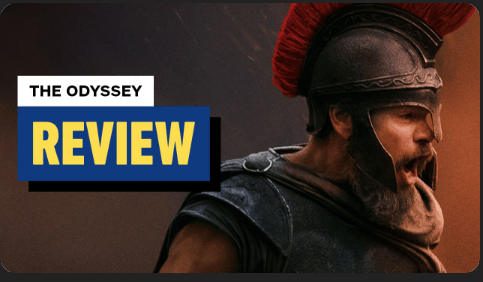
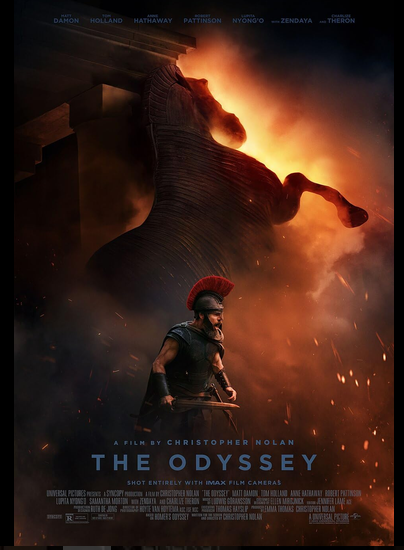
The 2026 film The Odyssey is quite controversial for some reasons — mostly the director Christopher Nolan’s insistence on his own personal interpretation of the classical mythological story of Odysseus or Ulysses and the Trojan War. I have my own misgivings about his interpretation.
TROJAN HORSE
First off, the iconic Trojan Horse as depicted in the film is half submerged in water when the Trojans came to inspect it. That means, some of the men inside the horse could have drowned before it was moved to higher ground.
Next, the massive statue was not even on a platform to make it stand and be stable. And so, it was pulled while the horse was lying on its side. There were no sliders or rollers that would make the transport of the horse easier.
If that happened in reality, the Trojans, instead of spending so much time and effort and using so many men to move it, would probable decide to just burn it on the beach, where it was, as an offering to Aphrodite or Zeus or whoever their patron god / goddess was.
Homer did not mention the Trojan Horse in the Iliad; and mentioned it only in passing in The Odyssey. The movie showed the scene where Menelaus and Helen reminisced about Odysseus and the Trojan War when Telemachus came to visit them, as described in Homer’s epic poem.
But Virgil, in his Aeneid, described how the Horse was moved. He wrote that the Greeks put gliding rollers (or wheels) under the horse statue’s feet (pedibusque rotarum subiciunt lapsus ). In Aeneid, it says: “We divide the walls and open the ramparts of the city. All gird themselves for the work, and place under its feet. the glidings of wheels, and stretch hemp bonds around its neck.”
Tryphiodorus , a Greek poet from Egypt (around the 3rd or 4th century CE), in the short poem The Taking of Ilios, also noted the use of rollers and wheels to move the massive statue.
AGAMEMNON WAS NOT KING OF ALL GREEKS
Whatever gave Nolan the idea that Agamemnon was the sovereign of Odysseus? Agamemnon was the King of Mycenae and the Commander of the Greek forces. Although Mycenae was a powerful kingdom, it was not an Empire. His younger brother Menelaus became the King of Sparta after marrying Helen; Achilles was the King of Phthia; Ajax, the King of Salamis; Diomedes, the King of Argos, and Nestor, the King of Pylos.
Odysseus was himself a king — the King of Ithaca. In the film Ulysses (1954) with Kirk Douglas, the character Ulysses kept on identifying himself as Ulysses, King of Ithaca. Being King was a part of his identity. And a king does not bow down to another king. But Nolan’s Odysseus kept on bowing down to Agamemnon, and even addressed him as his king. Nolan should have watched Troy (2004) where Achilles did not bow down to Agamemnon.
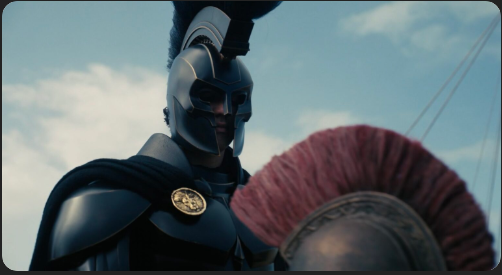
Agamemnon did not order the Greek kings and princes to enlist in the war against Troy. Many of the Greek kings and princes vied for the hand of Helen. Helen refused to choose because she reasoned that if she did, the suitors might kill the chosen man or attack them.
But the cunning Odysseus told Tyndareus, the father of Clytemnestra and step-father of Helen, that he had thought of the solution. He would tell Tyndareus if he promised to help Odysseus get Penelope as his wife. Penelope was the daughter of Tyndareus’s brother Icarus, former king of Sparta.
Odysseus’s idea was that all the suitors, including Odysseus, should swear a most solemn oath to defend the chosen husband of Helen against whoever should quarrel with him. This was called the Oath of Tyndareus.
Helen chose Menelaus, Agamemnon got Helen’s step-sister Clytemnestra while Odysseus got Helen’s and Clytemnestra’s first cousin Penelope.
In Nolan’s movie, Helen and Clytemnestra were twins.
HELEN WAS BLACK
In Nolan’s universe, the most beautiful woman of the Greek world was Black. And so was her twin. And they married the Atreus brothers – Menelaus and Agamemnon – the most powerful men of the Greek realm. But why is Penelope, their first cousin, not Black or a mulatto?
Helen is Western literature’s icon of Beauty. She was immortalized not only by Homer but also by Christopher Marlowe in Dr. Faustus where these famous lines come from:
“Was this the face that launched a thousand ships
And burned the topless towers of Illium?
Sweet Helen, make me immortal with a kiss”
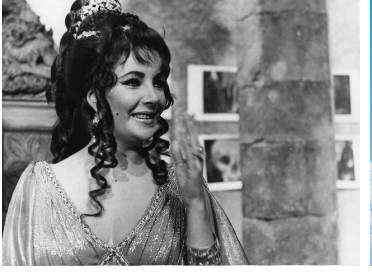
I memorized those lines when I was in grade school, imagining of course Elizabeth Taylor as Helen to Richard Burton’s Dr. Faustus.
I also memorized in high school Edgar Alan Poe’s poem, To Helen:
Helen, thy beauty is to me
Like those Nicean barks of yore,
That gently, o’er a perfum’d sea,
The weary way-worn wanderer bore
To his own native shore.
Nolan referenced Marlowe’s work when the character Menelaus introduced his wife as the face that launched a thousand ships. But Menelaus seemed sarcastic because his Helen was badly scarred, presumably by him.
Is Nolan being sarcastic by presenting the iconic beauty that was Helen into a quite ordinary looking person, and becoming badly scarred at that. Interestingly, Homer, Virgil and all other poets and writers of the ancient times never mentioned any facial scars on the beauteous Helen.
BELIEF IN NO GODS
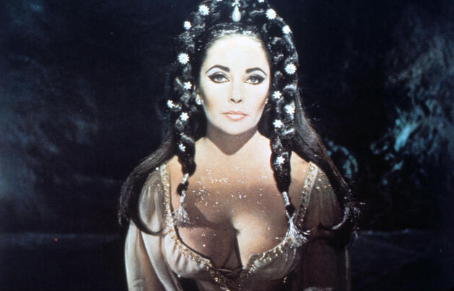
In the movie, the very modern-thinking Odysseus did not believe in gods or immortals. But why was Athena being shown with Odysseus. Was Odysseus hallucinating? Surely, he, like Nolan, did not believe in Athena.
And if he did not believe in the gods, why was he concerned that he and his comrades desecrated the statue of Athena, which he blames as the cause of the misfortunes that befell the Greek warriors?
BAD ANIMATION
The Cyclops Polyphemus looks like a giant golem. (“A golem is an animated anthropomorphic being in Jewish folklore that is created entirely from inanimate matter, usually clay or mud.” – Wiki) The cyclop animation of the 1954 film looks even better.
The Laestrygonians were featured as very tall knights in all-white metal armor. Like the cyclop Polyphemus, they were all Poseidon’s sons and were man-eating cannibals. But the cyclop looked like a giant Golem while the Laestrygonians looked like very tall immaculate-looking white knights.
DEGLAMORIZED WOMEN
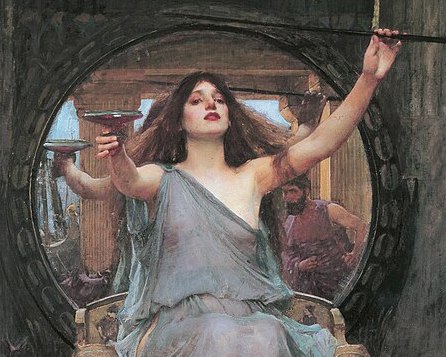
In the story of Odysseus, the womanizer, one would expect glamourized or enchanting women like Helen, Circe, Calypso and Penelope. In Nolan’s movie, only Penelope retained her dignified glamor.
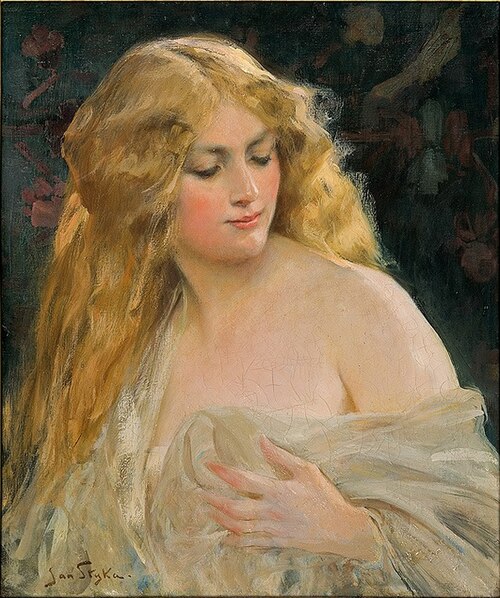
Helen was seen as a scar-faced woman. Circe the beautiful goddess is seen as a middle-aged ordinary-looking witch. In Homer’s epic poem, Odysseus was her lover for one year. In other poems and stories, she had children with Odysseus.
The goddess/nymph Calypso was portrayed by the beautiful Charlize Theron. But she was portrayed as some kind of a fisher folk, living by the sea, and totally un-glamorized. She and Odysseus lived together for 7 years.
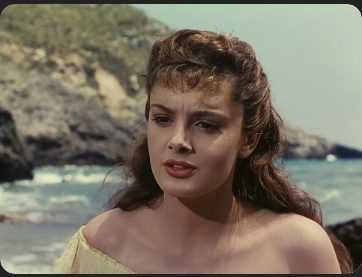
Nolan did not include the character Nausicaä , the Phaecian princess. Is it because many woke people would be offended to see a May-December couple on-screen even if off-screen, many Hollywood celebrity couples have huge age differences like Al Pacino (86) and his girlfriend Noor (32) and Robert De Niro (83) and his girlfriend Tiffany (46)?
HADES
Circe told Odysseus that he needed to visit Hades to talk to the blind prophet Tiresias. Odysseus said, “But nobody comes alive from Hades.” Circe answered, “You will.”
But Odysseus did not go down to the Underworld as depicted in myths and other movies. Hades, rather, its inhabitants, came up to the surface, to meet Odysseus. His men, too “went” with him to “Hades” and yet lived.
And in this Land of Departed Souls, the shade of Agamemnon appeared, and Odysseus bowed down to him again.
And worse, the shades of the dead warriors blamed him and his men of “dishonor”! And these shades attacked Odysseus and his men, who ran fast towards their ship.
DISHONOR ?
Nolan seems to put more modern values like his to the story of the late Bronze Age. Odysseus, as the film rightly says so, was the hero of the Trojan War.
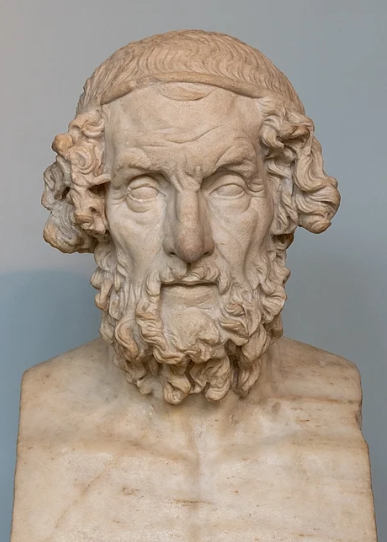
Neither Homer, author of the Iliad and The Odyssey, nor Virgil, who wrote Aeneid, condemned Odysseus of dishonor.
In Homer’s epic work, Odysseus was proclaimed a hero, whose Trojan Horse concept was a stroke of genius, a great military strategy. Greek warriors celebrated Odysseus and the Trojan Horse for reflecting the ancient heroic code of deception against an enemy in war.
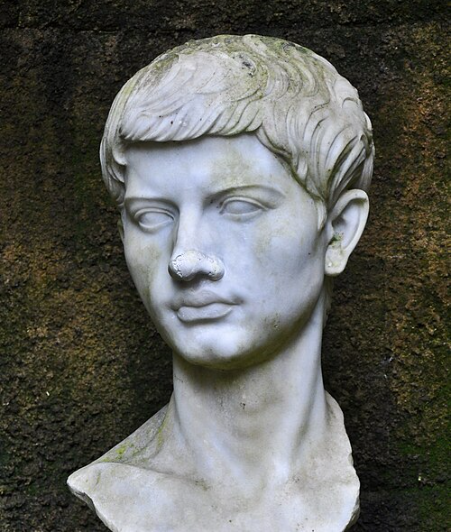
The Aeneid was written with the perspective of the defeated Trojans. While the Greeks were portrayed as treacherous and merciless, the Trojan Horse was not framed as an immoral and dishonorable act of Odysseus / Ulysses, worthy of punishment by the gods. It certainly did not go against the laws of Zeus or Jupiter.
And when it comes to dishonor, most of the Greek kings and warriors committed them time and again. Agamemnon’s sacrifice of his own daughter was mentioned in the film. How about Achilles’s dragging of the corpse of Hector as shown in the film Troy (2004)? Is taking the women captives for their concubines not considered dishonorable?
The “dishonorable” Odysseus came much later during the Roman times, by Roman authors much later than Virgil.
Aeneas, the son of the Trojan prince Anchises and the goddess Aphrodite / Venus. His father was a first cousin of King Priam of Troy, making Aeneas a second cousin to Priam’s sons Hector and Paris. He was the ancestor of Remus and Romulus, the founders of Rome.
Thus, Virgil , through the Aeneid, popularized, if not created the idea that linked Roman origins to the legendary Trojan War, shaping the cultural identity of Rome. Later Roman poets and writers, naturally, tried to make the Trojan heroes more heroic and the Greek heroes more villainous.
Maybe Nolan has Latin lineage somewhere, somehow?
And if Zeus’s law says one must be kind and welcoming to strangers, what does it say about the responsibilities of the strangers? Is invading a country with more than a thousand ships, and laying siege to the city-state for ten years not considered dishonorable?
ZEUS’s LAW
Zeus’s law, also known as xenia, is an all-important concept in Greek mythology that governs the relationship between hosts and guests. This law mandates that hosts must provide food, drink, and shelter to strangers before inquiring about their identity or purpose. Guests, in turn, are expected to show respect and reciprocate the hospitality.
Under this code, it was Paris and the Trojans who broke this law; whether Helen was abducted or that she eloped with Paris.
According to this law, Odysseus’s actions were not against this law. It is a bit of a stretch to say that the Trojan Horse violated Zeus’s law. There was no host-guest relationship there. They were at war for 10 years. It was a brutal war that resulted in deaths of kings, princes and warriors. The ancient Greeks were not travelers in search of shelter. And the Trojans were not welcoming hosts.
When he and his men blinded the Cyclops, it was self-defense. It was Polyphemus who broke the law. Instead of feeding the travelers, he fed on them.
Both Circe and Calypso broke the law. Odysseus was the victim.
In the 1954 film, it depicted the episode where Odysseus/Ulysses was shipwrecked in Phaeacia. The princess Nausicaä saw Odysseus, gave him clothes, and led him to her parents who welcomed him and gave him a ship and provisions that finally brought him home.
Nausicaä and her royal parents did well by Zeus’s Law. On the other hand, the suitors of Penelope broke Zeus’s Law every day they were in Penelope’s house. Abuse of hospitality in Odysseus’s home was every inch a violation of Zeus’s Law. Killing all of them was certainly a punishment in line with Zeus’s Law.
Nolan, on the other hand, believes that Odysseus was guilty of violating Zeus’s Law because those suitors were guests in his house. Nolan’s definition of guest is certainly amiss.
In Nolan’s convoluted sense of justice, the suitors were the victims! The suitors lived in Odysseus’s palace, consuming his food and wine daily, harassing the servants, and behaving arrogantly as if the house were their own. Some even fornicated with the female servants. And they were doing that for 10 to almost 20 years!
And because the suitors were not violating Zeus’s Law, Telemachus was not allowed to help his father fight the suitors, even if he was an excellent archer. And after the massacre of the suitors, Odysseus, the King of Ithaca, was exiled. His queen went with him, and the son became the king.
Fine, but who would sentence the King?! Not the gods, because Nolan and his Odysseus character do not believe in gods. Agamemnon, Nolan’s King of Kings could not have given the order because he was already in Hades!
In Homer’s The Odyssey, after the massacre of the suitors, Odysseus ordered the deaths of all female servants who fornicated with the suitors. He also gathered his forces to fight the relatives of the suitors, who were up in arms. Athena mediated and there was peace.
ADAPTED FILMS VS ORIGINAL WORKS
So as not to be bothered so much by the disconnect between an original work (book, long poems. plays, folk lore, myths, fairy tales, etc.) and an adapted film, I just consider the film as a totally different work, unrelated to the original piece. But sometimes, it just doesn’t work if the original literature is already well entrenched in the culture or sub culture for decades or even ages.
For example, there are 27 James Bond films and 12 novels written by Ian Fleming, starting with Casino Royale in 1953. The films began with Dr. No in 1962. If the new producers of James Bond films would decide to have a James Bond who is female or gay, I doubt if it would still be a blockbuster. Most probably, I wouldn’t bother watching it. The character Agent 007 could be female, gay or transgender, but he couldn’t be Bond; James Bond. The number of the Secret Agent is not important. It could be given to anyone. But the agent James Bond needs to have his very own personality. It is non-transferrable. And that personality has already been written by Ian Fleming in 12 novels and augmented by the 27 films.
When it comes to mythologies, there are frameworks — there are immortal beings, there are mortals, there are all kinds of supernatural powers, there are acknowledged relationships.
But in today’s films, writers and producers are mostly ignorant of the frameworks. Immortals die. How can that be? In the superhero movie Wonder Woman (2017), Ares (Mars), the god of War, had killed all the other gods of Olympus, presumably including Hades and Poseidon. How do gods and goddesses die? And he was defeated by a modern-day super hero, Wonder Woman. Totally ridiculous. By ridiculous, I mean deserving or inspiring ridicule; absurd, preposterous, or silly. (Americans now use the word ridiculous to mean great, super, etc. )
In the movies Clash of the Titans (1981) and (2010), there were no Titans at all!! The writers, directors, producers, and actors didn’t even know who were the Titans!!!
GREEK MYTHOLOGY AND ME
I love Greek mythology — the story of their heroes, warriors, gods and goddesses. I first heard the stories when I was in Grade 3. My sister, who was studying that in high school, used to read to me the stories of these mythical characters. Pretty soon, I memorized the names of the gods, goddesses, heroes and heroines.
But even before that, I saw Steve Reeves movies of Hercules and other heroes when I was not even 5 years old. I even saw a movie (made in Italy, I think) where Ulysses and Hercules were the protagonists. Later, I read Edith Hamilton’s Mythology. And in high school, we studied parts of The Iliad and the Odyssey and the Aeneid. I tried reading the whole Iliad and The Odyssey epic poems. And I’ve read more contemporary books on Greek mythology.
When I was 14 or 15, I invented a game, like Stratego or Game of the Generals, where there are two sides — the Trojans and the Greeks. The players are the warriors of both camps. Each piece has powers, depending on the Trojan War story. For example, the piece named Hector could capture any Greek pieces except Achilles. On the other hand, Achilles could capture any Trojan piece, except Paris.
Christopher Nolan is one of my favorite filmmakers. I love Memento (2000), The Prestige (2006), Inception (2010), Interstellar (2014), Dunkirk (2017), and Oppenheimer (2023). But I don’t like The Odyssey (2026). Nothing spectacular. Even the special effects are ordinary. But then, I did not see it on the big screen. And putting his own values on characters of the late Bronze Age (1300–1200 BC) simply doesn’t work. He can remove all the gods and goddesses, the magic and mysticism, but he cannot put his modern values on ancient characters and settings. The situations become absurd.
======================================


