


Debunking Heroes like Lapu-Lapu while
Upholding Colonizers like Magellan in Philippine Films
A grandson of the country’s first Commonwealth president expressed concern and anger at the portrayal of his grandfather in the movie about his granddad. Quezon (2025) is the fourth movie in the Bayani (Hero) quadrilogy that included Bonifacio, ang Unang Pangulo (2014), Heneral Luna (2015), and GOYO (2018). The theme of these movies appears to be the debunking of Philippine national heroes.
Today, a post appeared in my FB feed. A group listed what they think are the Best Filipino Films of the 21st century (2001-2025). I was surprised to see the four films mentioned above as among the top with Goyo and Heneral Luna in the 2nd and 3rd spots respectively. Quezon was in #15 while Bonifacio was in #21. The critics appear to favor period films or biopics.
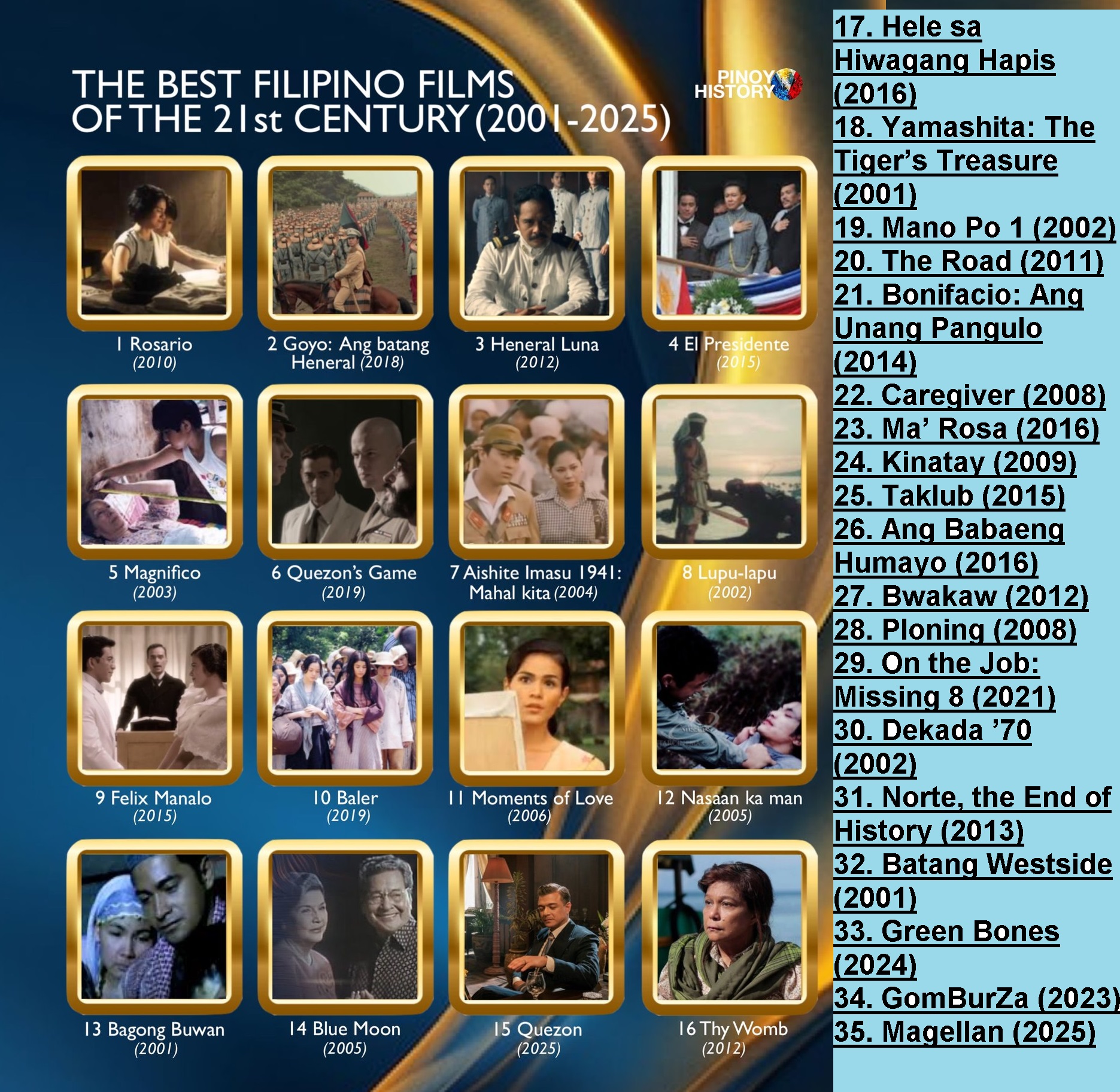
I was quite surprised to see Lapu Lapu (2002) in #8 and quite glad that Magellan (2025) was in the last spot (#35) despite the hype on the movie and its director by supposed cineastes. It also starred Hollywood actor, Gael Garcia Bernal.
I saw Magellan last month; and, I wrote an unfavorable review in my blog. I thought it was disgusting. I remember writing a critique of LapuLapu (2002) in 2003 as an academic exercise. I thought that was also disgusting. So, I am blogging the 2 movies together.
LAPU LAPU (2002)

This film was one of the entries to the 2002 Metro Manila Film Festival. This was touted as the film with the biggest budget in the filmfest.
SYNOPSIS OF THE FILM
Raha (Rajah) Humabon is the chief of Cebu while Raha Lapu-Lapu is the chief of Mactan, a little island off Cebu. Humabon wants to conquer Mactan so he could give it to his vassal Datu Zula. Humabon and Zula, with their followers, attack Mactan but are repulsed. Zula hatches a plot – to order his men to harass, kill and rape the people of Mactan.
Magellan with his giant ship arrives in Cebu. Humabon welcomes him. Humabon and his wife embrace Christianity while Magellan claims Cebu for the Spanish King (Carlos I). Humabon asks Magellan’s help in subduing Lapu-Lapu. Magellan, despite the protests of his colleagues, leads an attack on Mactan. Lapu-Lapu kills Magellan and the foreigners leave. Lapu-Lapu gains the admiration of Humabon but not of Zula. Zula and his men surreptitiously attack Lapu-Lapu while he is hunting game (wild boar). Lapu-Lapu is killed while being ignominiously tortured.
HISTORICAL INACCURACIES
The Director was interviewed on TV where he said he was quite happy about the historical research done by him and other members of the team.
According to Mario Bautista in his Malaya column (1/06/03) “the script has been approved as authentic by the National Historical Institute.” However, he could not help but add, “But they obviously took a lot of liberties in telling the story, so we’re not sure where artistic license ends and real history begins.”
It is difficult to imagine what the National Historical Institute means by historically authentic. Perhaps the dates were correct as well as some of the names of the protagonists. But that is as far as I would go.
The Spaniards were shown to be gentle and wise. Magellan’s companions were even against fighting Lapu-Lapu. The audience could not even savor the victory of Lapu-Lapu over the Spanish because almost immediately after the battle with the Europeans, Lapu-Lapu was tortured and killed by his fellow Indios.
Is there any historical truth in the movies’ narrative? Probably none.
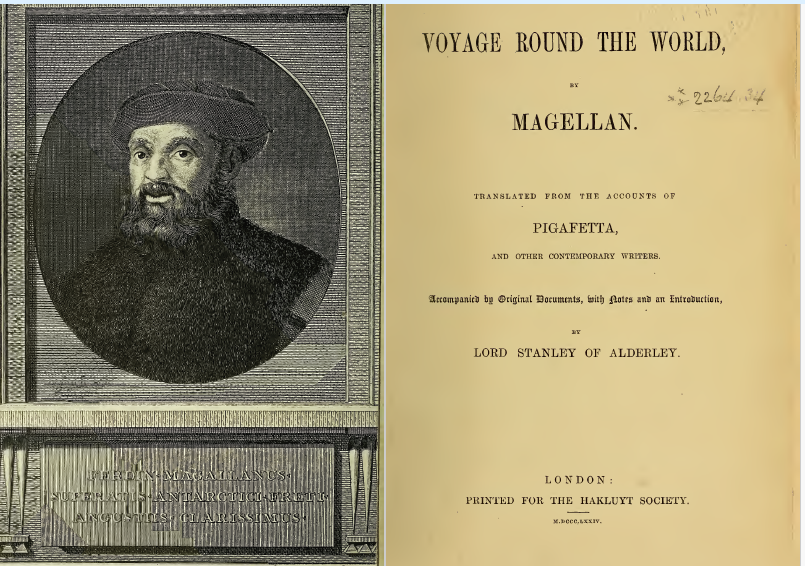
If the filmmakers just limited themselves to historical documents – the most important of which was Pigafetta’s eyewitness account, they could have made a great movie that would make Filipinos proud of having a non-Western Identity.
FOREVER DISUNITED
The film supports the dominant discourse that the Filipinos will never be united because they never were. As former President Ramos averred, the Philippines was just a confusion of barangays before the coming of the Spaniards. The dominant discourse would have Filipinos believe that without “Mother Spain” and “Mother America”, the Filipinos would still be living in the Stone Age.
It is interesting to note that Rajah Humabon was represented as wearing some sort of grass skirt or G-string. His contemporary rajahs and sultans in Mindanao, Brunei and Manila wore silk trousers, shirts and robes. Is it really difficult for Christian Filipinos to believe that before the Spanish came, their forefathers were already wearing pants and silk robes?[1] Or is it the elites (who believe that their forefathers were Spanish) who perpetuate such ideas about pre-Spanish natives?
MASSACRE OF MAGELLAN’S MEN
The Europeans lost 9 men, including their Captain-General, Ferdinand Magellan against Lapu-Lapu’s forces. Because of the death of their leader, the Europeans decided to leave Cebu and continue on to their mission. Humabon invited the European invaders to a farewell feast. Twenty six of Magellan’s companions, including the new Captain-General, Duarte Barbossa attended the feast offered by the Cebu rajah.
According to Pigafetta’s eyewitness account, when Lapu-Lapu proved victorious against the foreigners, Humabon realized that the Europeans were just ordinary men. He and his men thus conspired to treacherously murder the Europeans while they were enjoying their meals.
The skeletal crew manning the two ships immediately left Cebu. Pigafetta, who did not attend the feast because he was wounded in the battle with Lapu-Lapu, was in one of those ships.
Why is the massacre of the Europeans (Spanish, Portuguese, etc.) not included in the film? In fact, why is that quite important episode not mentioned in history textbooks in the Philippines? Why is there a “news blackout” of this historical event for around 500 years?
The answer is obvious. The Spanish and their colonial minded lackeys would never promote such publicity. Humabon and his wife are known as the first Filipino (Indio) Christian king and queen named after no less than the Spanish king and queen. Humabon’s later action proved that he was never a Christian in the real sense of the word.
In one Filipino website, the deaths of Magellan’s companions were explained thus:
Disputes over women caused relations between Raja Humabon and the remaining Spaniards to deteriorate. The Cebuanos killed 27 [2] Spaniards in a skirmish and the Spaniards, deciding to resume their explorations, departed Cebu.[3]
These Filipinos even resorted to fiction masquerading as historical facts.
In the New Millennium and in the Information Age, withholding or corrupting a seemingly harmless bit of historical information, more than 500 years old, is quite amazing. And the creative re-imagination of the massacre continues. The 2025 film Magellan, even gave a bizarre twist.
LAPU-LAPU’S RELIGION
Lapu-Lapu exemplifies the Moros’ stubborn fight against Western colonialism. In fact, Many Moros believe that Lapu-Lapu was a Moro. And some Christians have an uneasy feeling that Lapu-Lapu might turn out to be a Moro.
First, the Moros were everywhere in the Indo-Malay archipelago during that time. Pigafetta even mentioned that their group met and held hostage the king (rajah) of Manila and his son/nephew when they (Magellan and company) passed by Borneo.
Second, in the Philippine Declaration of Independence, Lapu-Lapu was mentioned as Cali Pulacu. Cali is derived from the Arabic Qadi, which means judge or religious leader. Today, the rank and title of Cali is still used in Moro societies.
Third, when Legazpi arrived in Cebu, the people of Mactan refused to pay homage to him, just as the generation before them did. (Noone: 1986) [4] This means that Mactan’s resistance to Magellan was not due solely to an individual (Lapu-Lapu) but to something else (perhaps religion as in the case of the Moros).
Fourth, at about the same time, historical papers in Kawayan (Leyte) indicate a Capitan Basio who fled Mactan because of harassment from the Spanish and the Moros (Historical Data Paper for the Town of Kawayan, in Historical Data Papers – Leyte [Vol. V]). This puts the Moros right in Mactan.
Fifth, Pigafetta noted that some of the local leaders were circumcised — a strong sign of Islamic influence.
Just to make sure the audience would not think of Lapu Lapu as Muslim; at then end of the film, Lapu Lapu was shown hunting wild boar or pig.
THE GLOBETROTTING SLAVE
The case of Enrique, Magellan’s slave, can also be an issue. In the film, the character identified himself as Enrique de (from) Malacca, native of Sumatra. Yet he was also the lover of Lapu-Lapu’s sister. He was therefore not a stranger to Mactan (yet for some reasons, he was a stranger to Cebu and Humabon’s people.) Are the filmmakers trying to support the assertion made by some Filipinos that Enrique was a Cebuano?
Before the Filipinos’ hopes go up, the basis for this hypothesis was the fact that in Pigafetta’s book, Enrique used some Cebuano words. Anybody who knows a bit of Malay and a bit of Cebuano will notice immediately similar words. For instance, bulan is the word for moon in both languages. In fact, there are numerous words in Tagalog, Maranao, Maguindanao, TauSug, etc. that can be found in the Malay language.
To argue that Enrique was Cebuano because he was able speak to Humabon would be futile. Pigafetta wrote that Enrique could only speak to the rulers and traders, not to the common people, who most probably did not speak the Court language, Malay. He noted that in his experience, practically all rulers in the Malay-Indonesian archipelago spoke several languages. It is historically documented that Malay was the ligua franca in practically all Indo-Malay royal courts. In Mindanao, Malay was the court language from the 15th to the 19thcenturies. Pigafetta also described Enrique as Moro, i.e., Muslim Malay.
But what is the reason for the recent insistence on Enrique? Does the Filipino prefer to be known as the globetrotting slave of Magellan rather than his slayer and perhaps the first freedom fighter of the Malay race? A globetrotting slave would indeed be a great icon for the nation of Domestic Helpers and Contract Workers. Is this another tactic of the elites (former Education Secretary Alejandro Roces is a strong supporter of the “Enrique was Cebuano” claim) to instill in the minds of the people that it is better to be a slave than a freedom fighter?
MAGELLAN (2025)

If Lapu Lapu (2002) was historically inaccurate, Magellan (2025) was not historical at all. It was a re-imagining of the Magellan-Lapu Lapu affair, with the convoluted imaginings of Lav Diaz. The 16th century Cebuanos were turned into a tattooed nudist colony with perverted, pagan rituals using animal blood.
Magellan convinced Rajah Humabon and his wife to become Christians when he brought with him a statue of Sto. Nino and told them the statue would heal their child. He also gave them jam, which they used to heal scurvy. The child was cured and so the whole village accepted Christianity.
Of course, this happened only in Lav Diaz’s mind. It’s a facile way of convincing the viewers that the natives converted to Christianity upon seeing the miracle of Christ.
CEBU’S HERO TURNED INTO A BEASTLY PHANTOM
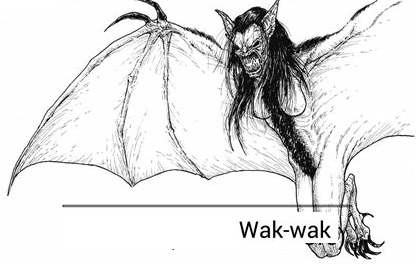
Lapu Lapu was turned into a “wak wak” or aswang or manananggal! A wakwak “is a vampiric, bird-like creature like yaya in Philippine mythology. It is said to snatch humans at night as prey, similar to the manananggal and the Ekek in rural areas of the Philippines.” (Wikipedia)
Humabon told Magellan that Lapu Lapu, a wakwak, was against the foreigners. It would have been an ingenious idea: Humabon’s men would kill the foreigners at night, individually or in numbers, and blame it on the mythical creature. But it was not implemented.
Magellan, who did not believe in phantom monsters, decided to attack this wakwak immediately. He brought with him a few Europeans armed only in spears and swords. But the question is: where and who would they attack? The film didn’t say where and who.
The natives – whoever or wherever they were – were ready for them. They were not the Stone Age villagers who meekly welcomed the colonizers and accepted their religion. They turned out to be fierce warriors. Most of the Europeans, including Magellan, and a whole lot of natives were killed. Diaz’s Cebuano fighters must have had long experience fighting wakwaks.
Diaz’s scenario took care of two things: It relegated Lapu Lapu into oblivion or a mere myth while skipping altogether the unmentionable – the massacre of the remaining top officers of Magellan by Humabon and his men.
LAV DIAZ: “LAPU LAPU NEVER EXISTED“
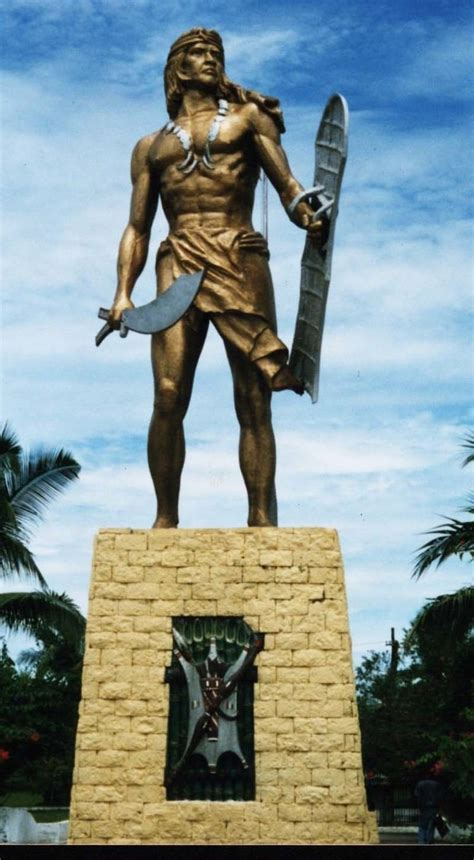
In an interview, Diaz questioned the existence of Lapu Lapu. “Nobody saw him, nobody knows what he looks like,” he said. Obviously, he has not read Pigafetta’s eyewitness account of Magellan’s voyage. Does he know how they all looked like — Rajah Humabon, his wife, the other rajahs and datus who met Magellan’s group? And was Zula, the other chief of Mactan, the rival of LapuLapu also non-existent? The Europeans had not seen him either. But he caused the Battle of Mactan. Or, was the battle of Mactan just a figment of the imagination of Antonio Pigafetta?
In one fell swoop, the ancestors of the Cebuanos were turned into a barbaric cult, far from any civilization, clad in nothing except for tattoos. But their leaders and some of the people were inexplicably fully attired, including simple jewelry and headdresses.
And the great Lapu Lapu, one of Asia’s first fighters and the first Malay fighter for freedom against European colonization, and the Philippines’ first hero, was turned into a myth, a beastly phantom.
DIAZ’S REVENGE
The Director, Lav Diaz, was born in Cotabato, a Moro-dominated province. While growing up, the Moro revolution started and battles between Moros and the Christian settlers allied with the armed forces. Diaz’s family had to transfer residence to a more peaceful part of the province. He graduated from the prime Christian university of the province, Notre Dame University.
As with most Christian settlers in Mindanao, especially those who lived there at the height of the Moro Revolution in the early 1970s, hatred for Moros is a given.
As mentioned earlier, many Moros and some Christians think that Lapu Lapu was a Moro. For most Christian settlers, it must be terribly irritating if the first Filipino hero turned out to be a Moro. So, he did what he could to malign him – turn him into a figment of the imagination, and a horrible one at that, a wakwak or a blood-sucking creature of the night.
Diaz justified his rendition of Lapu Lapu with his quip, “Nobody saw him, nobody knows what he looks like!”
A GLOBE-TROTTING SLAVE FROM CEBU, AGAIN
And one of the agenda of Lav Diaz was some Filipinos’ insistence that Magellan’s slave, Enrique, was a Cebuano. If the movie Lapu Lapu (2002) only hinted that Enrique could be a Cebuano, Diaz asserted that he indeed was. In fact, Enrique was a leading character, next only to Magellan, in Diaz’s film.
Diaz and other Filipinos base their assumption that Enrique was a Visayan on the indications that Enrique translated for Magellan.
For Lav Diaz and many Filipinos, Rajah Humabon, although he was a Rajah, a Sanskrit word for King, was just a chief of a Stone Age village. So, anybody who spoke their language must be from that place. Hence, Enrique must have been from Cebu.
They of course forgot that the Visayas, from its very name, must be part of the Sri Vijaya Empire, and later, the Majapahit Empire and the Muslim Malay Empire. All Philippine history books taught that.
From the Laguna Copperplate dated 900 AD, the inscription in it provides crucial evidence of a complex, pre-colonial Philippine civilization and its connections with other Southeast Asian regions, such as Indonesia and Malaysia, challenging previous notions of the islands’ isolation before Spanish arrival. It was also written in Old Malay, with some Sanskrit terms and written in Jawi.
All historical documents proved that in the 16th century, the lingua franca in Southeast Asian royal courts was Malay. The letter of the Sultans of Maguindanao and Sulu and the Rajah of Buayan during those times were written in Malay. And most importantly, the dominant ethnic groups in Luzon, Visayas, and Mindanao were Malay.
Therefore, a Malay, like Enrique, could speak Malay with Rajah Humabon, a royal Malay. He did not have to speak Cebuano.
In the film, Enrique said he was sold as a slave many times, from a Chinese to an Arab to a Malay, etc. But if Cebu was a Stone Age village far from civilization, as pictured in the movie, how did Enrique end up in Malacca?
FIRST CIRCUMNAVIGATOR OF THE WORLD
As mentioned earlier, many Filipinos are obsessed that Enrique, a slave, be acknowledged as Cebuano and be known as one of the first people to circumnavigate the globe. And if he did return to Malacca, he would be the first person to circumnavigate the globe and returned to his point of origin.
Even in history, the Filipinos want to be famous as a world-traveling Domestic Helper or OFW (Overseas Foreign Worker)! But there’s a problem here. There is no evidence whatsoever that Enrique was able to go back to Malacca, thus circumnavigating the globe. His last known location was Cebu, which was still far from Malacca. He was 2500 km short of circumnavigating the globe! And if he did go back to Malacca, then that would be proof positive that he was not from Cebu.

Why would a slave like Enrique make the Cebuanos proud? According to Antonio Pigafetta, 18 Europeans returned to Spain, thus circumnavigating the globe aboard the ship Victoria. Three Moluccans accompanied the 18 Europeans but they only traveled halfway around the globe. King Carlos I, awarded Victoria’s last captain, Juan Sebastián Elcano, a coat of arms bearing a globe and the Latin motto Primus circumdedisti me (You were the first to circumnavigate me).
According to some historians, Arabs had been circumnavigating the globe much earlier than Magellan.
FILIPINO SELF-BASHING
The Filipinos are known for self-deprecating, esp. in the presence of foreigners. This film is a great example of that. Portraying 16th century inhabitants of Cebu as naked savages with barbaric practices is a bit over-the-top. It exceeded the normal bounds of Filipino Self-Bashing. It shows the Filipino director’s great admiration for European colonizers and total disdain for his own roots.
Wouldn’t the Cebuanos be prouder of being descendants of Datu or Sri LapuLapu and Rajah Humabon, freedom fighters and conquerors of Spanish and Portuguese conquistadors?!! Humabon should not be known as the first Philippine native king to be converted to Christianity. He should be celebrated as the first native king (Rajah) to massacre a whole group of Spanish/Portuguese conquistadors!!! But this event has been CENSORED in Philippine textbooks and media for 500 years!!!
APPROVED BY EUROPEANS
Anyway, the Europeans loved Diaz’s film. It contained the necessary ingredients for European approval. First it shows Culture, ethnic culture — the more primitive the better, the more barbaric the better. (This gives Europeans a sense of superiority) Second, it contains nudity – always a plus factor for Europeans. Third, artsy-fartsy techniques like slow pace, tableau photography, montage editing, minimal props (really, because of lack of budget), etc. Fourth, a dose of violence. Fifth, period films are much appreciated, too. Sixth, poverty. Europeans seem to like seeing poverty in other nations. In this film, the Cebuanos were dirt-poor, contrary to the accounts of the eyewitness, Antonio Pigafetta.
Pigafetta described the time when they sold merchandise to the people of Cebu. From Pigafetta’s account, the Cebuanos appeared to be adept at trade. Magellan and his crew traded vigorously with them. In fact, he mentioned that they were told that a ship from Siam (Thailand), “laden with gold and slaves” had just visited Cebu and paid tributes to the Rajah. In fact, a merchant of that Siamese ship was still there to trade with gold and slaves. This shows that Cebu and the surrounding places were aware and probably practiced slave-trading. In fact, pre-Spanish Visayans, Tagalogs and most of the ethnic groups in the Philippine Islands practiced slavery. In the Visayas, slaves were called ulipon; among the Tagalogs, slaves were called alipin.
Diaz’s film seems to indicate that Cebu was just a source of slaves, who would be sold to Chinese, Arabs, Malaccans or Europeans like what supposedly happened to Enrique.
The Cebuanos also asked tribute from Magellan, but Magellan refused to give. Although he exchanged gifts with Rajah Humabon later. Pigafetta described the island of Cebu as:
In this island of Zubu there are dogs and cats, and other animals, whose flesh is eaten ; there is also rice, millet, panicum, and maize; there are also figs, oranges, lemons. sugar-canes, cocos, gourds, ginger, honey, and other such things ; they also make palm-wine of many qualities. Gold is abundant. The island is large, and has a good port with two entrances: one to the west, and the other to the east north-east. It is in ten degrees north latitude and 154 east longitude from the line of demarcation. In this island there are several towns, each of which has its principal men or chiefs.”
Pigafetta also observed a significant amount of gold jewelry and artifacts worn by the local rulers in Cebu and nearby Masawa and Calagan, which piqued Magellan’s interest during their visit. This encounter highlighted the wealth and culture of the region at that time.
BTW, Gael Garcia Bernal gave a very good performance. I was surprised that he took the role seriously.
MUTUAL MASSACRE
Lav Diaz would not want to anger Europeans or European-Americans by showing the Massacre of the Europeans by Humabon’s people. He might lose European awards and foreign financing. The Europeans would prefer doing the massacres, not being victims of them. Besides, there is still news black-out on the massacre of Europeans in Cebu, even after 504 years!
Diaz’s imagination made it a mutual massacre. Technically, it was a battle, not a massacre. Both groups suffered severely, with Magellan dying in battle. But he was not fighting Lapu Lapu, the proud and brave ruler of Mactan and his equally brave men. He was fighting a blood-sucking beastly phantom and brave Cebuanos, who became instant fighting warriors!
CONCLUSION
For me, Magellan (2025) was artistically, a sophomoric film — a nice effort from beginning filmmakers. Historically, it’s an idiotic film. It’s more of a fantasy than an historical film. As a Filipino, it’s a disgusting film that should be criticized and banned. It created a horrible picture of the 16th century natives of the Islands — barbaric, untouched by civilization, pure savages.
While Magellan was done on a presumably shoe-string budget, Lapu Lapu (2002) was a reportedly big budget extravaganza. While Diaz’s Cebuanos were like Stone Age naked people, whose leaders were fully attired, William Mayo’s Cebuanos have more modern weapons and even boats, and all were dressed, although some males in G-string or grass skirt.
Both directors – Mayo and Diaz – and their writers must have a seething anger against Lapu Lapu. In the first film, Lapu Lapu, after his great victory over the invading Europeans, was ignominiously tortured and killed by fellow Cebuanos. In the second film, Lapu Lapu did not even exist. He was just a myth cooked up by Humabon to threaten the invaders.
The story of Humabon and Lapu-Lapu has not been truly presented in history books. But it is a wonderful story of Fight for Freedom, Malay dignity and pride. Both Humabon and Lapu Lapu and all Visayans were Malays, except for a scattering of Indonesians and Negritos. Because of what Sri LapuLapu and Rajah Humabon and their people did; the Spaniards did not return to Cebu and the nearby big islands of Luzon and Mindanao for some 44 years.
How the Christian Filipino perceives Lapu-Lapu and Magellan has a big effect on the Moro-Christian Filipino conflict in the country. Magellan is seen as the bringer of Christianity to the Islands. Filipino identification with Magellan is inimical to his relation with the Moros, recognized as staunch defenders of their faith and homeland.
Christian Filipinos are either ambivalent or confused on how to regard Magellan and Lapu Lapu. This was exemplified by a congressional bill that sought to declare March 16 as Magellan Day to commemorate the “discovery” of the Philippines, and April 27 as Lapu-Lapu Day to celebrate Filipino resistance against invasion.
But Christian identification with Lapu-Lapu might make them realize that an Easterner can stand up to a Westerner and even overcome him. They might start to actually push the Westerners off their pedestals. They would be able to stand shoulder to shoulder with foreigners. [5]
In history, Lapu Lapu and his men killed Magellan and some of his men. But, in the minds of Christian Filipinos, can the idea of Lapu Lapu, the great defender of Freedom, ever slay the great image of Magellan, the man who “discovered” the Philippines and gave Christianity to the majority of the natives?
====================
ENDNOTES:
[1] In the play Lorenzo Ruiz, a Spanish officer complemented Ruiz on his wearing trousers instead of the usual Chinese dress, “O ngayon, mukhang tao ka na!” (Now, you look like a human being!). The Western-style trousers were supposed to represent civilization. The Filipino playwright did not realize that the Chinese were already wearing trousers when European men were still wearing skirts and gowns.
[2] Actually only 26. Enrique, Magellan’s slave was not killed according to Pigafetta but his name was listed in the official (Spanish government) list of those who died in Cebu.
[3] http://www.barkada.de/docs/spanish_era.html
[4] Noone, Martin J., SSC (1986) The Discovery and Conquest of the Philippines, 1521- 1581 Manila: Historical Conservation Society, p. 362
[5] In my own experience, I have seen Christian Filipinos, including high government officials, get tongue-tied and intimidated by foreigners. In a graduate class in economics, I asked our professor, a former Secretary of Finance, if his Harvard education helped him in his negotiations with World Bank / IMF officials. He said that it helped him not to be intimidated by the Westerners. But how many Filipinos can afford a Harvard education?

 Postprandial Musings, 2.0