

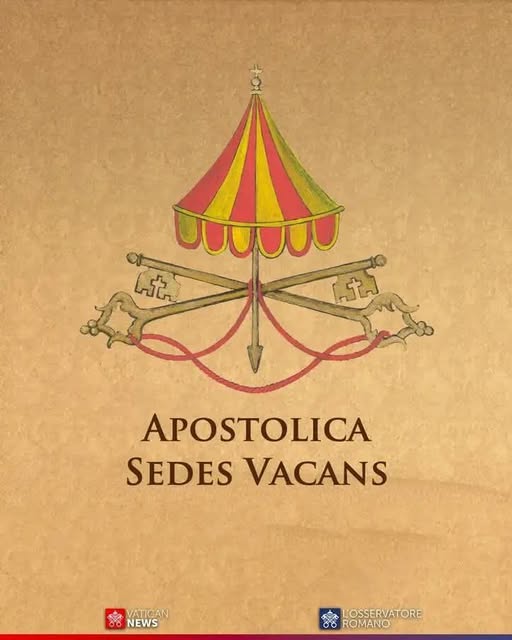
The Bishop of Rome, Vicar of Jesus Christ, Successor of the Prince of the Apostles, Supreme Pontiff of the Universal Church, Primate of Italy, Archbishop and Metropolitan of the Roman Province, Sovereign of the Vatican City State, and Servant of the Servants of God, better known as Pope Francis is dead.
Pope Francis passed away on Easter Monday, April 21, 2025. He was 88. He died in Vatican City, in the guesthouse where he had chosen to live instead of the grand papal palace. He had a stroke. His heart gave out.
Jorge Mario Bergoglio was born in Buenos Aires, Argentina on December 17, 1936. He was the oldest of five kids. His father worked as an accountant. His mother stayed home with the children. He studied chemistry before joining the Jesuits. That was in 1958. He became a priest in 1969. Years later, he was named Archbishop of Buenos Aires. Then he became a cardinal. In 2013, everything changed. Pope Benedict XVI stepped down. Bergoglio was elected pope.
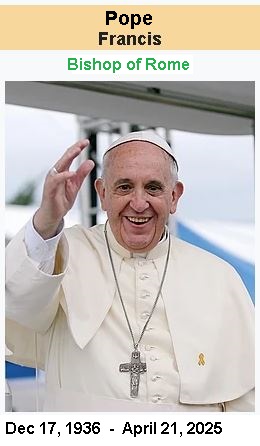
POPE, the FIRST
St. Malachy, in the 1100s, was supposed to have made a prophecy where he listed the names and brief descriptions of the Popes to follow the then pope, Celestin II who was elected in 1130. The last Pope was supposed to be Number 112, which coincided with Pope Francis. But he ended up being the First…
For his pontifical name, Bergoglio chose Francis, after Saint Francis of Assisi. It was a simple name – a name for someone who cared deeply about the poor. He was the first pope of that name. Nobody from the Society of Jesus ever became pope, until Francis. He was the first Jesuit pope. He was the first pope from the Americas. And he was the first (technically speaking) non-European pope in over a thousand years. He was also the first Pope to share the papal palace with a Pope Emeritus.
He was known for being humble. He didn’t like fancy things. He rode around in a small car. He wore plain shoes; lived simply. He spoke often about mercy and about listening to others. He wanted the Church to welcome everyone, not just the few who followed all the rules.
He wasn’t afraid to talk about tough problems. He called out the abuse crisis in the Church. He pushed for financial reforms in the Vatican. He was pro- climate change and against war. He was concerned about poverty and refugees. He traveled around the world, even to places where world leaders wouldn’t dare go.
THE ENVIRONMENTAL CAMPAIGNER
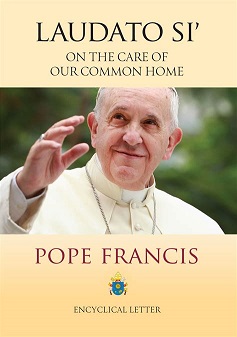
Pope Francis’s encyclical Laudato Si’ (Praise Be To You) in 2015 established him as a powerful advocate and campaigner for environmental protection. The subtitle of the letter is On Care for Our Common Home, Earth being humanity’s common home. It is thus a call for the world to protect our planet from climate change, degradation, consumerism, etc. as well as improving the lives of the impoverished.
He cried out against air and water pollution, climate change and global warming, loss of biodiversity and the general breakdown of society. He wrote: “Never have we so hurt and mistreated our common home as we have in the last two hundred years.”
The Church encouraged its constituents to form a movement, the Laudato Si’ movement all over the Catholic world. Kofi Annan, former chief of the United Nations said: “As Pope Francis reaffirms, climate change is an all-encompassing threat. … I applaud the Pope for his strong moral and ethical leadership. We need more of such inspired leadership. Will we see it at the climate summit in Paris.”
Filipino Luis Cardinal Tagle wrote: “In Laudato Si’ Pope Francis reminds us to replace consumption with a sense of sacrifice, greed with generosity and wastefulness with a spirit of sharing. We must “give, and not simply give up”. We are called to free ourselves from all that is heavy and negative and wasteful and to enter into dialogue with our global family.” (See here)

AGING AND DECLINING HEALTH
In his later years, his health suffered. He had trouble breathing. On Feb. 18, he was hospitalized for double, or bilateral, pneumonia. Complications upon complications made him stay at the hospital for 38 days. He was supposed to have a 2-month rest at his Vatican home.
On April 6, just two weeks after his discharge from the hospital, he greeted crowds at St. Peter’s Square to mark the Jubilee of the Sick and the World of Healthcare.
On April 17, Pope Francis met individually with each of the 70 inmates at Regina Coeli prison in Rome.
On April 19, he made a short visit to St. Peter’s Basilica to pray before the Easter vigil on Saturday evening and greet some of the faithful present. He did not attend a meeting with US Vice President JD Vance.
He kept working; right up until the end. His last public appearance was on Easter Sunday, the day before he died. He’ll be buried in the Basilica of St. Mary Major, just as he wanted. It’s not the usual place for a pope to be buried. But Pope Francis was never one to follow tradition for tradition’s sake.”
JD VANCE and the US IMMIGRATION POLICY
US Vice President JD Vance, who converted to Roman Catholicism in 2019, seemed to have little regard for the Church, as he attacked the U.S. Conference of Catholic Bishops (USCCB) in January this year for assisting the immigrants. The AP reported: “Vance suggested the bishops were in it for the money. ‘Are they worried about humanitarian concerns or are they actually worried about their bottom line?’ Vance said.”
The Bishops answered: “In our agreements with the government, the USCCB receives funds to do this work; however, these funds are not sufficient to cover the entire cost of these programs,” the statement said. “Nonetheless, this remains a work of mercy and ministry of the Church.”
Vance defended Trump’s immigration policies by invoking the Catholic concept of “ordo amoris” (the order of love) by asserting that “the well-being of Americans trumped any concern for that of immigrants.” (See here) To answer Vance, the Pope wrote a letter to the Bishops of USA dated 10 February 2025. He wrote, among others:
“4. I have followed closely the major crisis that is taking place in the United States with the initiation of a program of mass deportations. The rightly formed conscience cannot fail to make a critical judgment and express its disagreement with any measure that tacitly or explicitly identifies the illegal status of some migrants with criminality… the act of deporting people who in many cases have left their own land for reasons of extreme poverty, insecurity, exploitation, persecution or serious deterioration of the environment, damages the dignity of many men and women, and of entire families, and places them in a state of particular vulnerability and defenselessness.”
As for ordo amoris, the Pope wrote:
“6. Christians know very well that it is only by affirming the infinite dignity of all that our own identity as persons and as communities reaches its maturity. Christian love is not a concentric expansion of interests that little by little extend to other persons and groups. In other words: the human person is not a mere individual, relatively expansive, with some philanthropic feelings! The human person is a subject with dignity who, through the constitutive relationship with all, especially with the poorest, can gradually mature in his identity and vocation. The true ordo amoris that must be promoted is that which we discover by meditating constantly on the parable of the “Good Samaritan” (cf. Lk 10:25-37), that is, by meditating on the love that builds a fraternity open to all, without exception.” (See the Pope’s Letter)
MEETING WITH JD VANCE
Last Saturday, April 19, the Pope did not meet with VP Vance. Instead, he sent his deputy Cardinal Pietro Parolin and the Vatican Foreign Minister Archbishop Paul Gallagher to meet with the American. Apparently, the very articulate and top-notch debater Vance was able to convince the cardinals to arrange for a meeting with the Pope.
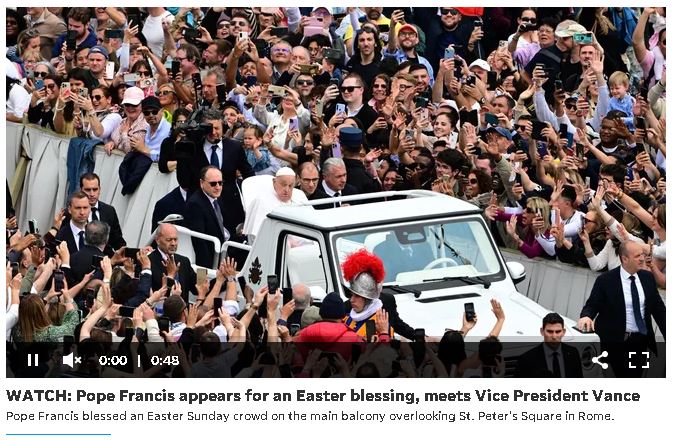
Last Sunday, after a very hectic day, including greeting his parishioners outside aboard the Pope Mobile, the Pope had an unscheduled meeting with the American VP. Ironically, Pope Francis’s official Easter sermon inveighed against antagonism toward immigrants and international aid, the hallmarks of the current White House policy. In his Easter sermon, the Pope asked, “How much contempt is stirred up at times toward the vulnerable, the marginalized and migrants?”

Less than 8 hours later, on Easter Monday, the Pope died. What must have been in the mind of Pope Francis when he passed away? As expected, the World Wide Web was bombarded with messages inimical to Vance. Some were even calling him the “Anti Christ”.
THE POPE AND GAZA GENOCIDE
The book Hope Never Disappoints. Pilgrims Towards a Better World is supposed to be the Pope Francis’s book for the 2025 Jubilee year. The book is about the Pope’s views on contemporary issues ranging from family and new technologies to climate change and the War on Gaza. It is compiled by journalist Hernán Reyes Alcaide. Published and released in Italy, Spain, and Latin America in November last year, the Pope said, “According to some experts, what is happening in Gaza has the characteristics of genocide. It should be carefully investigated to determine whether it fits into the technical definition formulated by jurists and international bodies.”
It must be noted that the Pope said that even before South Africa filed a case against Israel at the International Court of Justice last December for alleged violations of the Genocide Convention. In his final address from the balcony overlooking St. Peter’s Square, the Pope repeated his call for a ceasefire in Gaza, and condemned the “deplorable humanitarian situation.”
ST. MALACHY’S PROPHECY
Some people remembered an old prophecy when he became pope. As mentioned earlier, a list of popes was supposedly written by Saint Malachy, a 12th-century archbishop from Ireland. He wrote a list of 112 short phrases, each one believed to describe a future pope. Francis was number 112. According to the prophecy, he would be the last pope.
The line for him was “Peter the Roman.” That puzzled many. His name wasn’t Peter, and he was from Argentina. Still, some pointed to his birth name, Jorge Mario Bergoglio—his father was Italian. And he took the name Francis, like Saint Francis of Assisi, who was originally named Giovanni di Pietro. That means “John, son of Peter.” For those who believed, the clues were enough.
Pope Francis never commented on the prophecy. He stayed focused on his mission—serving the poor, healing wounds, and leading with kindness. But the idea lingered in the minds of many. Was he truly the last? Or just a symbol of a turning point?
He leaves behind a Church still facing many questions. But also a Church more open, more honest, more aware of the world outside its doors.
He was a different kind of pope. And many people, even those outside the Church, will remember him with respect. And maybe even a little love.
Requiescat in pace Papa Francis, Episcopus Romae

 Postprandial Musings, 2.0