

(Or My Life at UP CMC Graduate School during Nemenzo’s Presidency)
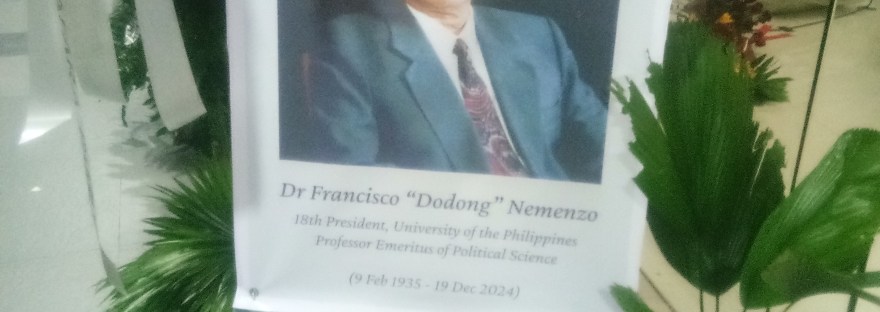
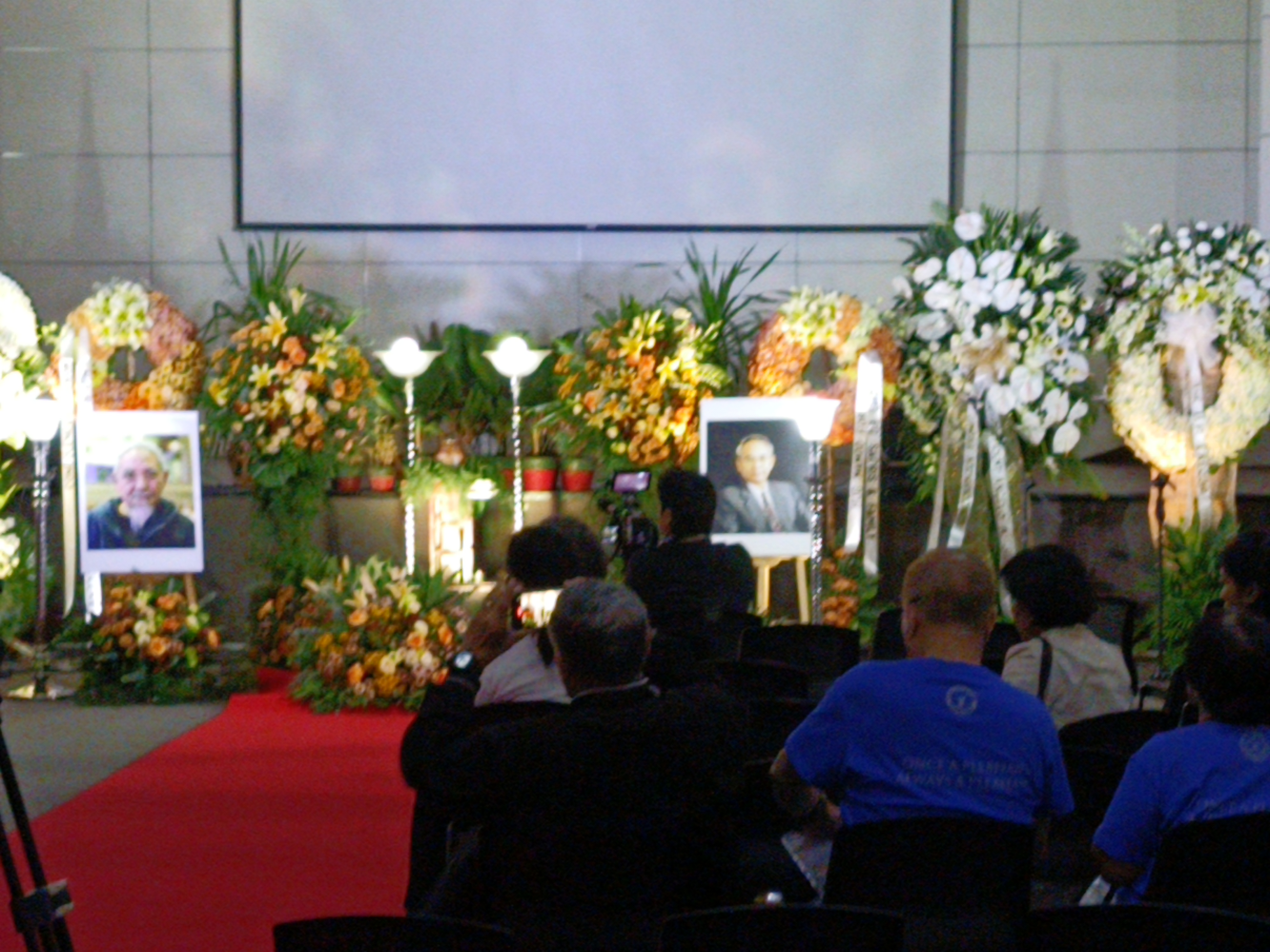
Last night, Khrysta and I went to the wake of Dr. Francisco Nemenzo at the GT-Toyota Asian Center Auditorium, UP Diliman.

I first met Dr. Nemenzo in the late 1990s at a get-together at the residence of then Inter-Press Service (IPS) chief Kunda Dixit.
In 1999, the selection for the UP Presidency came up. Nemenzo was running. He seemed to be the candidate of the UP Community. He was running against two nationally prominent personalities — former Minister of Economic Planning Gerardo Sicat and former Senator Leticia Ramos-Shahani. Another UP professor also ran.
Senator Shahani finished her elementary and secondary schooling at UP, but graduated from abroad for her A.B., M.A., and PhD. degrees. She taught at other schools, both in the US and the Philippines, but not at UP. She therefore asked people with connections to UP for help. She was closely in-touch with my brother Jun Abbas, who was a former Grand Archon of the Sigma Rho fraternity. I was, of course, rooting for Dr. Nemenzo.
BACK TO SCHOOL
In 2000, A friend convinced me to take one course in Film Studies. We officially enrolled (but non-credit) for the class. We had another non-credit student there, a Fil-Am who was an earnest film buff.
I asked the Dean if I could enroll for an M.A. degree in Film. Dr. Ellen Paglinuan said that there was no such degree being offered but they were working on it. She recommended that I enroll first under the M.A. Journalism degree and later transfer to Film Studies. Thus, I started my graduate studies at UP, finishing with an M.A. in Media Studies (Film) degree, the First Filipino to graduate with such a degree in a Philippine university.
As a graduate student, I did not have much to do with Quezon Hall, the UP administration building. Once, Dr. Borromeo, then Dean of the College of Music invited Khrysta and I to attend a concert there. We met there Dr. Nemenzo and his wife.
The College of Mass Communication’s (CMC’s) Graduation Students’ Association (GSA) president Rene Molina invited Dr. Nemenzo to induct its officers at the Balai Alumni restaurant. He had dinner with us. The following year, I became the GSA president but I did not invite anyone but the Dean of our College. We held the ceremonies at the UP Hotel.
In Feb. 2003, just before the the invasion of Iraq, UP held a discussion / symposium on the US war on Iraq. President Nemenzo sent a memo to the UP community urging them to protest the war. The Diliman Chancellor sent a memo for teachers to excuse the students who would attend the symposium followed by a candle-lit march for peace. I went there. It was pitiful. There were very few students. Nemenzo and other professors and students spoke. A paper by Nemenzo entitled “Hands off Iraq” was distributed there. Nemenzo wrote:
“If the peoples of the world applaud him as our government does, Bush will be encouraged to attack the other elements of what he calls the “axis of evil”. The Texas cowboy seems bent on intervening wherever US power is challenged. North Korea and Cuba may be next in line. Peace is the unlikely outcome of such an adventure. It is more likely to foment religious discord and a wave of retaliatory actions. Let it not be said the UP stood silent as the Bush-fire grows into conflagration.”
Unfortunately, the pitiful number of students in attendance in that symposium and candle-lit march, it seems like it could be said that UP stood silent. In fact, although channel 7 was there to cover the event, it was not shown on TV. Like the majority of Filipinos, UP students were in awe of USA and totally biased against Muslims.
In 2004, I was interviewed by Rod Fajardo III for the UP Newsletter. It was a long feature consisting of two articles.

The writer invited me to have lunch with Dr. Nemenzo and his colleagues at Quezon Hall. I shared a meal for the second time with Dr. Nemenzo.
A few weeks later, I was invited to an FGD at the CMC. Ms. Nemenzo and Von Hernandez were also invited. I was pleasantly surprised when Ms. Nemenzo and Von said they had read the UP Newsletter’s features on me.
When I finished my M.A. degree in 2004, I attended only the graduation ceremonies of the College. I did not attend the graduation ceremonies of the University, which was presided by Dr. Nemenzo. I think it was the last graduation ceremony with Dr. Nemenzo as president.
NEMENZO’S SON, FIDEL
Dr. Francisco Nemenzo’s son Dr. Fidel Nemenzo became UP Chancellor in 2020. He was the UP Diliman Chancellor during the pandemic. When he ran for President and later for re-election as Chancellor, Khrysta joined his campaign team.
It was unfortunate that Fidel’s run for the presidency, and later the Chancellorship were unsuccessful. I kept on telling Khrysta that in order to win at UP, one must get the nod of Malacanang.
Khrysta invited me to join one of their activities — a free Arroz Caldo merienda at the Oval. Later, the group had dinner at the UP hotel. Twenty years after I got my MA degree from UP, I again met Dr. Francisco Nemenzo. He aged a lot, due to sickness. We exchanged some small talk. I asked him how he won the UP presidency. His answer: Malacanang.
On Dec. 19, 2024, Dr. Francisco Nemenzo passed away at the age of 89. It must be a sad Christmas for the family and friends of Dr. Francsco ‘Dodong’ Nemenzo.
DR. NEMENZO, the INTELLECTUAL ACTIVIST
Dodong Nemenzo was a principled activist who worked for the rights of the people. None of his successors could be described as such,
He was a distinguished Filipino political scientist, academic, and activist. He is well-known for his significant contributions to political thought and education in the Philippines and his commitment to fighting for the rights of the Filipino people.

Dr. Nemenzo has been a vocal advocate for democracy, social justice, and national sovereignty. He has consistently championed the rights of the Filipino people, particularly in his opposition to authoritarianism and his efforts to promote good governance. As an intellectual and activist, he played a key role in shaping the discourse on nationalism and progressive politics in the Philippines.
During the Martial Law period under Ferdinand Marcos, he was one of the intellectuals who stood against repression and fought for democracy, often risking his safety to support the Filipino people’s struggle for freedom.
Academic Contributions
Dr. Nemenzo is best known for his tenure as the president of the University of the Philippines (UP) from 1999 to 2005. Under his leadership, UP strengthened its reputation as a bastion of academic freedom and a center for critical discourse on pressing national issues. He also served as a professor and department chair in political science, where he mentored generations of scholars and activists.
FOREMOST FILIPINO MARXIST
Jose Mari Sison, the founder of the Communist Party of the Philippines was usually labeled as a Maoist, not a Marxist. I thought that the older generation of Socialist/Communist leaders of the Philippines were Marxists like Pedro Abad Santos and the Lava brothers while the next generation of leaders like Joma were Maoists. I did not know that there were/are current Filipino socialist thinkers like Nemenzo who were/are Marxists. But then, even Mao was a Marxist.
In my Communication and Society as well as Communication Theories courses, I included discussions on Marxism and the various Marxist theories like those of Adorno, Althusser, Hokheimer, Gramsci, and of course, Karl Marx. I gave lengthy lectures on Marx’s excellent analysis of the weaknesses of Capitalism. I would have loved to have had Dr. Nemenzo as my professor.
Writings and Publications
Dr. Nemenzo has written extensively on topics such as nationalism, socialism, and political economy. His works often critique the dominant political and economic systems in the Philippines and advocate for alternative frameworks. He has written numerous essays and papers on Filipino politics and society, published in academic journals and books. Dr. Nemenzo authored and contributed to books focused on political theory, governance, and national development.
One of his notable works is his critique of neoliberal economic policies and advocacy for a more people-centered development paradigm.
Dr. Francisco Nemenzo’s work bridges the gap between scholarship and activism, making him a respected figure in both academia and social movements. His influence continues to inspire those who fight for justice and equality in the Philippines.
Some of his most significant works include:
U.P. Into the 21st Century and Other Essays
A collection of essays published in 2000, reflecting on the challenges and prospects of the University of the Philippines as it entered the new millennium.
Marxism in the Philippines: Marx Centennial Lectures
Published in 1984, this book compiles lectures discussing the application and relevance of Marxist theory in the Philippine context.
Questioning Marx, Critiquing Marxism: Reflections on the Ideological Crisis on the Left
An article from 1992 that examines the challenges and ideological crises faced by leftist movements, particularly in the Philippines.
Armed Communist Movements in Southeast Asia
A 1984 publication analyzing the various armed communist movements across Southeast Asia, including their origins, strategies, and impacts.
The Philippines After Marcos
Published in 1985, this work explores the political landscape of the Philippines following the ousting of President Ferdinand Marcos, offering insights into the country’s transition and challenges.
These works highlight Dr. Nemenzo’s critical engagement with political issues and his contributions to academic discourse in the Philippines.
Francisco Nemenzo, “The Millenarian-Populist Aspects of Filipino Marxism”;
Questioning Marx, Critiquing Marxism Reflections on the Ideological Crisis on the Left
Nemenzo, F. (2000). U.P. into the 21st century and other essays. University of the Philippines Press.
======

 Postprandial Musings, 2.0